


 8:14 AM
 shakir ali

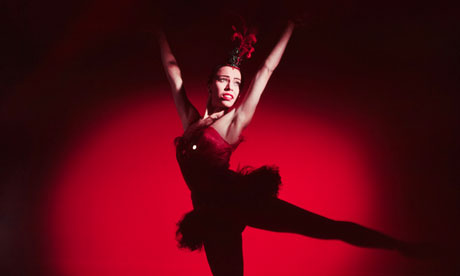
Maria Tallchief, who has died aged 88, was the quintessential American ballerina. As the dancer Jacques d'Amboise put it: "The English have their Fonteyn; the French, Chauviré; the Russians, Ulanova; the Cubans, Alonso; and now the US could claim their Tallchief." At the height of her career she was considered to be the most technically brilliant ballerina the US had ever produced. Tallchief was indissolubly linked with some of George Balanchine's most important works. The critic Francis Mason wrote: "Balanchine always wanted to do it his way. I believe that the dancer who helped him most to do it his way, the dancer who with him established the reputation of the young New York City Ballet and led the public to appreciate his ballets, is Maria Tallchief."She was born Elizabeth Marie Tall Chief in Fairfax, Oklahoma, the eldest of three children of Alexander Joseph Tall Chief, of the Native American Osage tribe, and his second wife, Ruth, who had a Scottish-Irish heritage. Two years later came a second daughter, Marjorie, who would also become a ballerina, and then a son, Jerry. Ballet lessons began at three, unhappily with an incompetent teacher. But when the family moved to Los Angeles in 1933 a chance inquiry led her to an excellent studio run by Ernest Belcher. She and her sister appeared in concerts and recitals, although they were less than happy when performing a supposed Native American dance, not least because, as Tallchief explained, "traditionally women didn't dance in Indian tribal ceremonies". They were both relieved when they outgrew the costumes. When, in 1938, Bronislava Nijinska opened a studio in Los Angeles, the sisters moved there to study. Nijinska proved to be an inspirational teacher. "In her studio I committed to becoming a ballerina," Tallchief wrote. Previously she had considered a career as a concert pianist. When she auditioned for the Ballet Russe de Monte Carlo there was initially no vacancy, but travel restrictions caused by the second world war meant that members of the company who had Nansen passports were unable to travel to Canada for performances. So her professional career began.By the time she was in her second season with the company, she had begun to understudy leading roles, and when Balanchine arrived to choreograph the dances for a production of Song of Norway his eye fell on the young woman who by then had adopted the name Maria Tallchief. Balanchine continued working with the company and Tallchief was cast in a number of revivals including Le Baiser de la Fée, in which she danced the role of the Fairy. She also created the role of the Coquette in his Night Shadow. Tallchief and Balanchine married in 1946. She completed her contract with Ballet Russe and then joined him in Paris where he had a six-month contract with the ballet of the Opera. She became the first US dancer of the 20th century to appear on the stage of the Palais Garnier. On returning to New York, she took her place in 1947 as ballerina with Ballet Society, the group formed by Balanchine and Lincoln Kirstein that eventually became New York City Ballet. There she was to dance in virtually all Balanchine's ballets. Many of the roles in which he cast her were designed to extend her technique and artistry and transform her into the prototype Balanchine ballerina. Tallchief recalled how after six years dancing for him "the very proportions of my body, the configuration of my legs and torso, were different". Among the ballets in which Tallchief created leading roles were Symphonie Concertante, Orpheus, Firebird, Bourrée Fantasque, Scotch Symphony, Allegro Brillante and Gounod Symphony, plus his version of Swan Lake. She was also the first Sugar Plum Fairy in Balanchine's Nutcracker. In 1965 she left New York City Ballet because, as she said: "I will accept alphabetical billing, but I will not be treated alphabetically." She had already taken leave of absence to dance with Ballet Russe at the highest salary ever then paid to a dancer. Her marriage to Balanchine had been annulled on the grounds that he did not want children. A brief marriage to Elmourza Natirboff was dissolved and in 1956 she married Henry "Buzz" Paschen. She gave birth to their daughter, Elise, in 1959. Tallchief was induced into the National Women's Hall of Fame and received a Kennedy Centre honour and the National medal of arts. Her husband died in 2004. Tallchief is survived by Elise, now a distinguished poet; two grandchildren; and her sister.
News source: www.guardian.co.uk


